
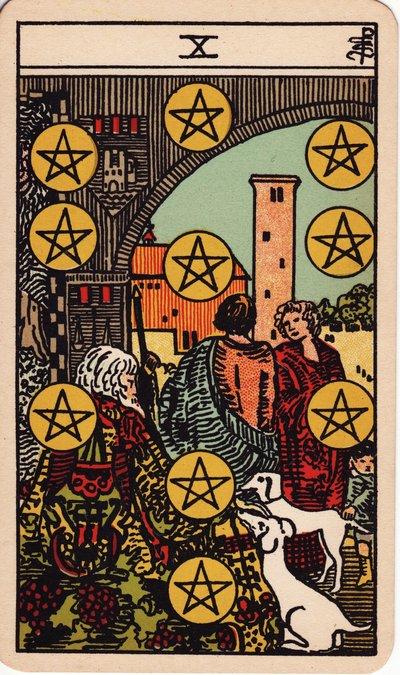
Ten of Pentacles
Pentacles • Earth • Number 10
More from Ten of Pentacles
Tarot Card Meaning • Love
Ten of Pentacles in Love
The Ten of Pentacles in love is the romance of legacy, a bond that asks not only do I love you, but what are we building that will outlast us. Three generations gather under the arch of a family crest, the old man flanked by two hounds.
Upright — Ten of Pentacles in Love
In a love reading, the Ten of Pentacles speaks of love grown into something structural: marriage, children, shared property, in-laws, and traditions woven together under one arch. The image of generations gathered around a family crest captures the feeling of belonging to something larger than two people, a love that has become a home other people live inside. This card blesses the slow work of turning passion into permanence, and reminds you that a shared home is one of the deepest forms of devotion. It also asks you to notice who is included in your future: love is rarely only about the two of you, so look at the wider circle you are building or entering, and choose it with your eyes open.
Reversed — Ten of Pentacles in Love
The Ten's shadow in love is a bond built on the wrong foundation, status, money, or family expectation instead of genuine connection. You may be planning a future while quietly unsure the present can hold it, or drafting a life together that is really a script handed down by others. Legacy pressure, a disapproving family, or inherited patterns can strain even a warm bond, and the grand arch begins to feel less like shelter than like obligation. The invitation is to ask whose dream this house actually is, and to repair the foundation before you keep adding floors to it.
A question to take with you
Ask what foundation your love actually rests on, and whether it is yours or your family's. Have one honest conversation this week about what kind of future you both actually want, not the one you feel expected to want. Belonging should feel like a choice, not a duty.
Keep exploring love card meanings
Want the full picture of Ten of Pentacles?
Browse all 78 cards in the library →