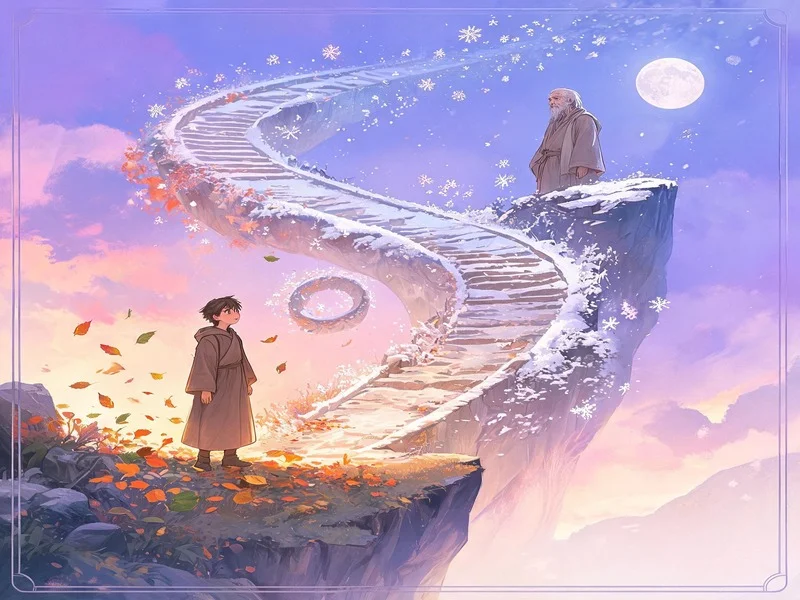
The Fool's Journey is not a path. It's a spiral.

Last Tuesday, around 9pm, a woman named Diana sat across from me and asked if she should quit her job. She pulled The Fool. She looked at me like I'd just handed her a parking ticket. "I'm 42," she said. "I have a mortgage. What the hell does this card want from me?"
I told her the truth: The Fool doesn't care about her mortgage. The Fool doesn't even know what a mortgage is. The Fool just sees the edge of a cliff and thinks, Huh. I wonder what's down there.
And that's exactly why she needed him.
I'll be honest: I used to roll my eyes at the whole concept of the Fool's Journey. It felt like something rich people on retreats talked about while sipping adaptogenic tea. But then I started seeing it everywhere—not in books, but in my own readings. The woman who pulled The Tower and then called me three weeks later to say, "You won't believe what happened." The guy who kept drawing The Hermit until he finally deleted his dating apps. The Fool's Journey isn't a metaphor. It's the plot of every single life.
Here's the thing: the Fool's Journey is the story the Major Arcana tells when you line the cards up from 0 to XXI. And it's been colonized by a lot of neat, tidy interpretations that I think miss the point entirely. You've probably seen the diagram: The Fool starts at 0, bounces through The Magician, The High Priestess, all the way to The World, and then... what? Fade to black? Cut to credits?
No. The World feeds right back into The Fool. The journey is a spiral, not a line. And that changes everything.
What Exactly Is the Fool's Journey in Tarot?
If you're new to this, or if you've been reading tarot for years but never really clicked with the narrative stuff, here's the basic shape of it:

The Major Arcana is, on its own, a story. A human story. You start as The Fool—naive, open, carrying everything you own in a little bindle over your shoulder. You don't know the rules. You don't know what you're doing. But you step off the cliff anyway, because that's the only way the story can start.
Then you meet people. The Magician teaches you that you have tools. The High Priestess whispers that you have a gut. The Empress and The Emperor show up to teach you about pleasure and structure, and just when you think you've got it figured out, The Chariot runs you over and forces you to pick a direction.
That's the first act. Then things get messier.
Because the Fool's Journey tarot card meanings aren't linear. You don't just complete Strength once and move on. You'll be 38 years old, standing in your kitchen, weeping over a burnt pan of brownies, and realize you're doing the Strength thing again—trying to tame the beast inside you that just wanted a snack.
The whole framework is a map of human development, from infancy to old age, from ignorance to wisdom. But wisdom isn't a destination. It's a practice. And the Major Arcana sequence in the Fool's Journey reflects that, because the cards loop back on themselves all the time.
Here's a take that will get me in trouble with the tarot purists: the Fool's Journey is not a straight line. It's a Möbius strip. You're always at the beginning and the end at the same time. That's not a flaw in the system. That's the whole point.
Meet the Fool: The Archetype of Infinite Potential
Let's talk about Card 0 itself for a minute.
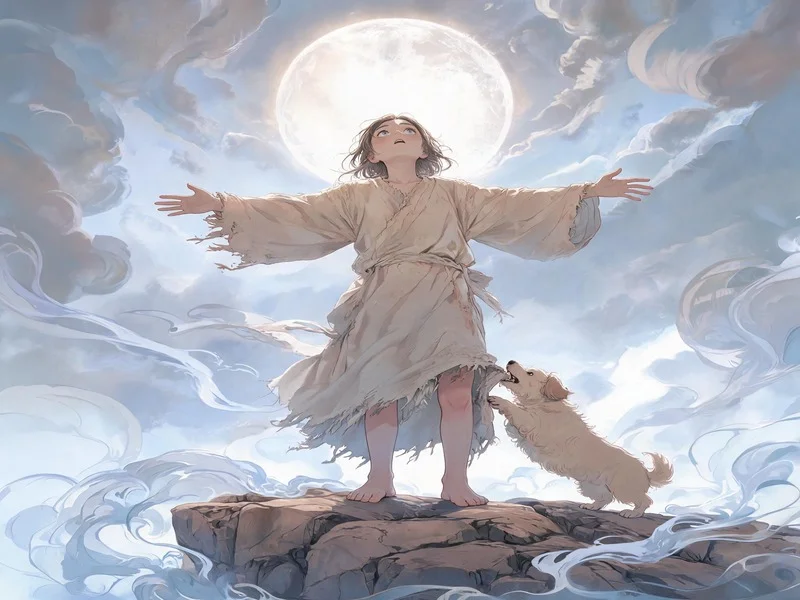
The Fool is the only card in the Major Arcana that isn't assigned a number in the traditional sequence—well, it's 0, which isn't really a number. It's a void. A circle. A zero that contains everything and nothing. And there he stands, on a cliff edge, one foot in the air, looking up at the sky instead of down at the drop. Tiny. Barely there. A dog yapping at his heels (I've always read that dog as anxiety, not a friendly companion—you can fight me on that).
The Fool archetype in tarot is the part of you that still believes in possibility. Not the gullible part—the brave part. The part that starts a new painting even though you might ruin the canvas. The part that says "I love you" first. The part that applies for the job you're not qualified for.
I pulled The Fool for myself on New Year's Day a few years ago. I was in my pajamas at 2pm, eating cold leftover pasta straight from the container. The card felt like an insult. But I wrote in my journal: "I am starting something I don't understand." And I was. I just didn't know what yet.
For beginners in tarot—for anyone, actually—The Fool is the gateway. You can't do the Fool's Journey for beginners without starting here, but here's the thing nobody tells you: you're always starting here. Every new cycle, every new chapter, every time you think you've got your life figured out and then the universe politely coughs and points at a completely different door.
The spiritual awakening through the Fool's Journey isn't some mystical weekend retreat. It's the moment you admit you don't know. That's it. That's the whole secret.
The Journey Unfolds: Key Stages from Innocence to Enlightenment
Okay, let's actually walk through this thing. But I'm going to do it my way, because the standard "three acts" structure bores me, and I think it lies to you.
Stage One: The Novice (0–VII)
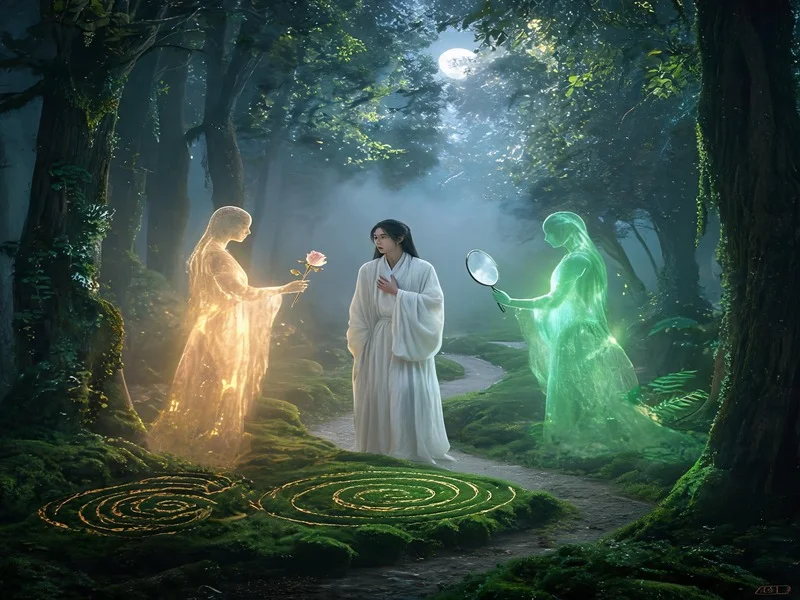
The Fool meets The Magician and thinks, "Oh, I can DO things." Then The High Priestess shows up and says, "But can you listen?" The Empress wraps you in a hug and feeds you. The Emperor builds you a house. The Hierophant finds you a community.
And then The Lovers show up and ask: Who are you choosing to be? Not who are you dating—who are you being? That's a values question, not a romance question.
The Chariot is the end of this act. You've learned the rules. You've picked a direction. You're pulling the reins on a pair of sphinxes that want to go two different ways, and you have to hold them steady.
Stage Two: The Seeker (VIII–XIV)
This is where the Fool's Journey stages and lessons get really uncomfortable.
Strength is a woman calmly closing a lion's mouth. No chains. No cage. Just eye contact and presence. That is the hardest thing you will ever learn.
The Hermit is the card that shows up when everyone else leaves. You're alone. You're climbing a mountain. But you have a lantern, and the lantern shows you one step at a time.
Wheel of Fortune is the spinning moment when you realize how little control you have. Then Justice weighs the scales and says, "What you sow, you reap." The Hanged Man is the stall. The pause. The upside-down perspective that comes when you finally stop thrashing.
Death is not literal death. It's the end of a chapter. And if you're reading this and thinking, "Great, another person telling me Death is transformation," fine. But let me tell you: real transformations look like 3am panic attacks, deleted photos, sold furniture, and crying in your car in the parking lot of a grocery store because you saw your ex's car and you felt like you were going to die.
Temperance is the integration. The angel mixing water and fire. It says: You can hold both. You can be both. Nothing is wasted.
Stage Three: The Return (XV–XXI)
This is where everything falls apart again.
The Devil is the shadow. Your addictions, your patterns, your comfortable chains. The Tower strikes it all down—whether you're ready or not. The Star is the first breath after the explosion. The Moon is the confusion that follows. The Sun is the joy that comes when you stop fighting.
Judgement is a reckoning with your past selves. And The World is the completion of the cycle—the dance, the wreath, the applause.
But here's the part that never gets explained: The World is not the end. The World is a door. And behind that door is The Fool again, ready to leap off a new cliff.
The Fool's Journey and shadow work integration happen every single time you circle back. You don't just face the Devil once. You face the Devil with a face tattoo the second time. The lessons get deeper. The questions get harder. The Fool gets older, but he never stops being a fool.
How the Major Arcana Mirrors Your Own Self-Discovery
I remember sitting in a coffee shop in Portland, the kind with exposed brick and a line out the door, and a friend said to me: "I don't need tarot. I have a therapist."
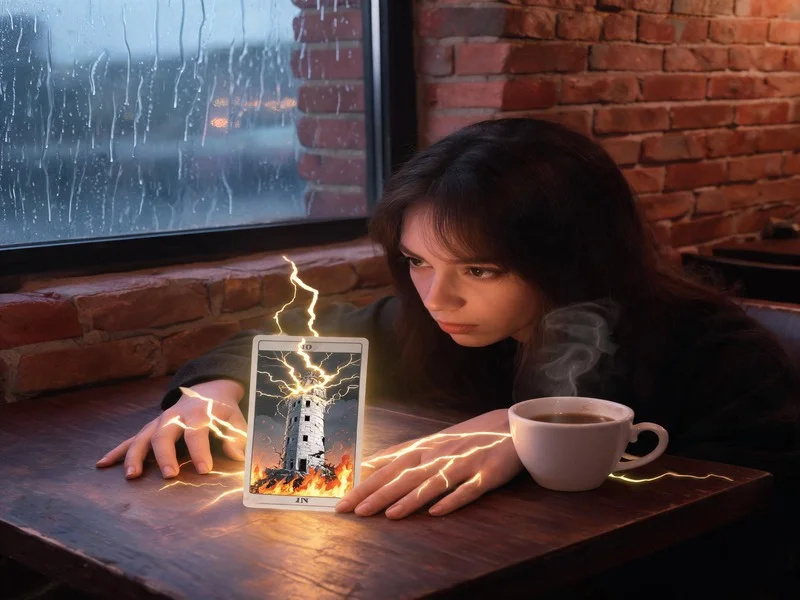
And I said, "Fine. Does your therapist show you a picture of a lightning-struck tower and say, 'This is what's happening to your marriage right now'?"
She didn't have a good answer for that.
The tarot journey of self-discovery isn't therapy, but it can be therapeutic. And the Major Arcana as a spiritual journey works because it gives you a visual for what's going on inside you. When I'm feeling stuck, I don't just say "I'm stuck." I think about The Hanged Man. I picture myself suspended by my ankle, seeing everything upside down. And then I think: What would I see if I actually looked at the world this way?
Here's a practice I use with my favorite clients: when you draw a Major Arcana card in a reading, ask yourself simply, "Where am I on this journey?" Not "What does this card mean?" But "how is my own life currently illustrating this card?"
Last month, I pulled The Hermit for a guy who was about to give a big presentation. He said, "Does this mean I should cancel? Too much alone time?"
I said, "No. It means you need to stop asking everyone what they think and go into your own room with a lantern. You already know what to say. You're just scared."
He gave the presentation. It went fine. He sent me a text that just said: "Hermit was right."
That's the tarot journey of self-discovery, right there. It's not magic. It's permission.
Practical Ways to Work with the Fool's Journey in Your Tarot Practice
If you want to actually use this, not just nod along at blog posts, here are some things that work.
First: draw a daily 'Fool card'.
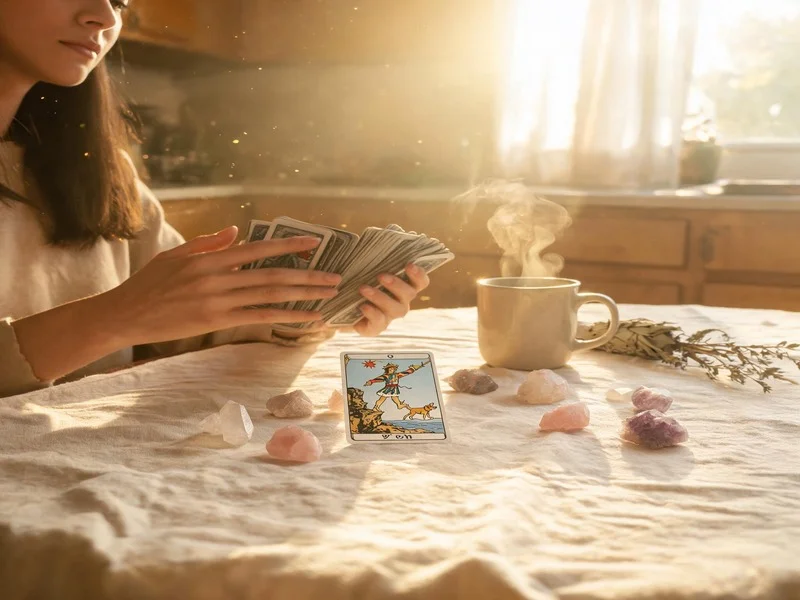
Not like a daily draw where you pick from all 78. A daily Fool card comes from the Major Arcana only. Shuffle. Pick one. And ask yourself, "Where is this card showing up in my life today?"
I did this for a month during a particularly chaotic winter. On days I pulled The Tower, I braced myself. But it wasn't catastrophic—it was my car breaking down on the freeway. Annoying, expensive, but survivable. On days I pulled The Empress, I inevitably ate something incredible or had a really good nap. The system is shockingly accurate.
Second: make a visual journey map.
Buy a cheap poster board and a deck you don't mind taping. Lay out the 22 Major Arcana cards in a spiral, not a line—start with The Fool at the center and wind outward. Put it somewhere you'll see it. Add dates, names, little notes. When you're going through something hard, walk over to the map and ask yourself, "Which card is this?"
Third: use the Fool's Journey as a spread layout.
You can do this as a one-card-per-position spread, or you can do a bigger one for the full cycle. Here's a simple version I call "The Spiral":
- Position 1: Where I'm still fooling myself (The Fool reversed in life, not in card form)
- Position 2: What I think I want (The Magician)
- Position 3: What I intuitively need (The High Priestess)
- Position 4: What I'm chasing (The Chariot)
- Position 5: What I'm holding onto (The Hierophant)
- Position 6: What needs to die (Death)
- Position 7: What will be reborn (The Star)
You can pull all seven, or you can just journal with the question of where you are. But the usefulness of the Major Arcana as a spiritual journey is that it's already ordered. You don't have to invent a system. You just have to walk it.
Why the Fool's Journey Never Really Ends
Here's the conversation I have at least once a month with a client:
"I keep pulling The Fool. Does the universe want me to do something stupid?"
"Yes," I say. "And no. The universe wants you to do something new."
That's the thing about the Fool's Journey tarot card meanings. You can pull the same card at 25 and at 55 and the lesson is completely different. The card doesn't change. The Fool stays on the cliff. But you change. And then the card means something else.
The Fool's Journey never really ends because it's not a journey with a destination. It's a cycle. Harvest and Lammas and winter and spring. You sow seeds, you tend them, you harvest the abundance, and then you sink back into the dark and start again.
If it's Lammas right now—and let's be honest, this blog post is being read sometime in August, because that's when these seasonal keywords sneak in—you might be in the harvest phase. You're reaping what you sowed, maybe in February, when you made that decision that felt huge.
The World card is the harvest. But the harvest is not the end. The seeds from this year's harvest are going into the ground for next year's Fool's leap.
I think that's what people miss about the Fool's Journey. It's not a hero's journey that ends with a trophy. It's a farmer's journey. You plant. You water. You wait. You harvest. You give something back to the earth. And then you plant again.
Abundance is not a permanent state. It's a moment in a cycle.
So yes, pull The Fool when you're scared. Pull The Fool when you're 42 with a mortgage. Pull The Fool when you think you're too old, too tired, too broken, too behind.
Because the wheel is always turning. And The Fool doesn't know that the ground is far away.
And that's exactly why he's the only one who ever flies.
Frequently Asked Questions
What is The Fool's Journey in tarot?
It's the story the Major Arcana tells when you read the cards in order, from The Fool (0) to The World (XXI). The Fool starts out naive and open, then meets teachers, faces challenges, goes through dark night-of-the-soul moments, and eventually reaches enlightenment. Then the cycle starts again.
How is The Fool's Journey connected to the Major Arcana?
The Major Arcana IS the Fool's Journey. Each card is a stage on the path—The Magician is learning your tools, The Hermit is going inward, The Tower is a sudden breakdown, The Star is hope after crisis. When you study the Major Arcana sequence, you're studying a complete spiritual psychology.
Can I use The Fool's Journey in a tarot reading?
Absolutely. You can ask 'where am I on this journey right now' as a simple one-card draw. Or you can lay out all 22 Major Arcana cards as a spiral map and physically point to where you feel stuck. It's also a great framework for a seven-card spread examining the full cycle.
Why does The Fool's Journey repeat itself?
Because life is cyclical, not linear. You don't learn patience once and never need it again. Every time you circle back—through a breakup, a career change, a move—you go through The Fool's leap again. The lessons get deeper but the arc stays the same. That's the real meaning of the journey.
What is the difference between The Fool's Journey and the Hero's Journey?
The Hero's Journey usually ends with a victory and a return. The Fool's Journey ends with The World, which immediately loops back to The Fool. The Fool's Journey is less about winning and more about continuous growth, seasonal harvest, and starting over. It's a spiral, not an arc.